Choose the lane before the number
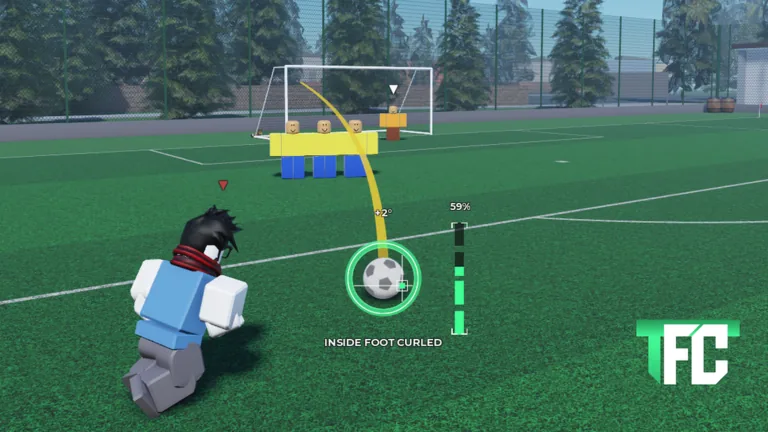
The That Freekick Challenge shooting angle display helps you compare setups, but the goal is a usable path to the net. Two official images show example values of +2° and +10° with a curved shot. Neither number is a guaranteed scoring angle. The wall, ball position, and goalkeeper create different problems in each setup, so choose the lane you need and use the readout to reproduce or refine it.
Start by checking where the curved trajectory passes the defensive wall. If it crosses a defender, adjust the angle until the route has visible clearance. Then check the end of the path near the goal. It is easy to clear the wall so widely that the ball no longer reaches the frame.
Make angle adjustments small enough to learn
Use one stable arrangement for several kicks. Take a baseline shot and note the displayed angle. For a second attempt, change only the angle and inspect how the guide moves. If the new path clears the wall but ends wide, move back toward your previous value in a smaller step. If it still intersects the wall, continue moving away from the contact point rather than changing power at the same time.
| Observation | Angle experiment |
|---|---|
| Guide crosses the wall | Move the route toward the open side of the wall. |
| Guide passes too far outside the goal | Move the target back toward the frame. |
| Keeper covers the chosen target | Test a different reachable side, then reassess wall clearance. |
| New setup changes ball position | Establish a new baseline instead of copying an old degree value. |
This is a visual, repeatable method. The official images show the angle readout, but they do not document how many degrees correspond to any particular distance on the pitch. An exact formula would be guesswork.
What about Q and E?
In a public TFC player duel, one participant tells another that Q and E can adjust the angle. That is a player-reported keyboard tip worth testing during practice. It is not an official, complete binding chart, and it says nothing about touch or controller input. Check the current on-screen prompts for your device before relying on those keys in a timed challenge.
If a key changes a different setting or does nothing, stop and use the live control hints. Avoid making a last-second change you cannot see on the readout. The whole point of the angle display is to confirm that the adjustment you intended actually happened.
Combine angle with the rest of the shot
Angle decides only part of the route. The selected shot type, visible curve, power setting, and chosen target also matter. Set a path that passes the wall, then test power if the ball’s distance or height is the remaining problem. If the goalkeeper saves an on-target ball, changing the target lane can be more useful than pushing the same angle farther.
Under a countdown, use a familiar baseline and one focused correction. The fastest reliable choice is rarely the most extreme value. It is the one whose route you can read before the kick.
FAQ
Is +10 degrees the best angle?
No. It is an example shown in one official image, not a universal recommendation.
Can Q and E change angle?
A player says so in a public TFC video. Test the keys and check current prompts on your platform.
Why does a larger angle miss the goal?
Moving the route around the wall can also move its endpoint outside the frame. Recheck the full path after each change.
Should I copy another player’s angle?
Use it only as a starting experiment when the ball, wall, and target are similar. Build a new baseline for a different setup.