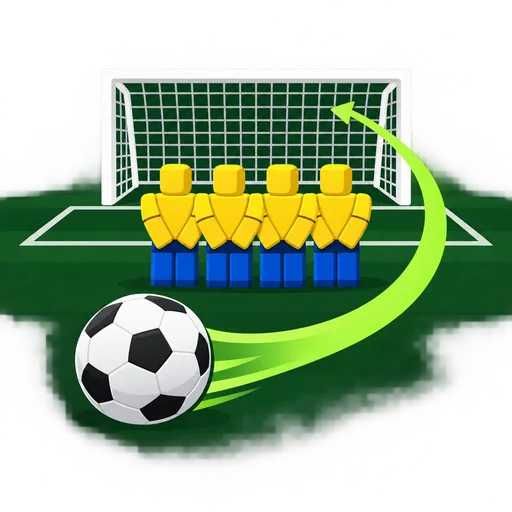
Read the line from ball to goal
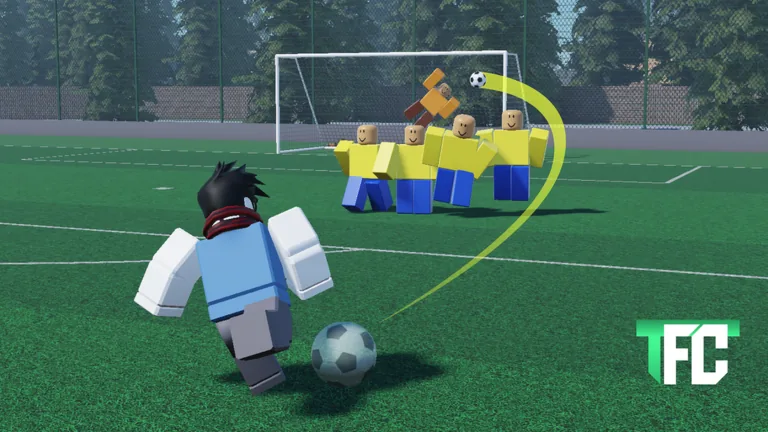
The curved yellow trajectory in That Freekick Challenge is a planning aid. Before you shoot, follow it from the ball past the defensive wall and toward the goal. The most useful question is simple: does this route clear the obstacle and still approach the target? A dramatic curve that misses the frame is not an improvement over a modest route that reaches the goal.
Official Roblox imagery shows the line in several setups, including one with additional obstacles. The images do not describe whether the preview is mathematically exact in every situation. Treat it as a guide to test against the real shot, then adjust from the result.
Divide the route into three checkpoints
First, inspect the space immediately in front of the ball. A setup with a nearby object can interrupt the shot before the wall is even relevant. Second, inspect the line where it passes the defensive wall. Look for visible separation rather than a line that barely touches a defender. Third, inspect the endpoint near the goalkeeper and goal. Clearing the first two checkpoints has little value if the line finishes outside the posts.
| Checkpoint | Good planning question |
|---|---|
| Ball to obstacle | Does the route start in open space? |
| Obstacle to wall | Where is the narrowest gap? |
| Wall to goal | Does the bend still reach an open target? |
This method gives you a specific reason for every change. If the wall is the problem, adjust the route where it crosses the wall. If the endpoint is the problem, shift the target. Do not alter the whole shot just because the previous kick failed.
Compare preview and result
Take one shot from a stable setup and remember the visible line. Afterward, identify the first important difference between the preview and the outcome. The ball may hit the wall, travel wide, be saved, or score. Record that category before setting up another kick.
On the next attempt, change one variable and watch whether the preview moves in the intended direction. If the line still runs through the wall, a power change alone has not answered the route problem. If the line clears the wall but misses wide, bring the endpoint closer to the frame. If the keeper saves a shot on target, pick another reachable lane.
The official images show example angle values and a percentage meter alongside the guide. Those numbers are useful for comparing your own attempts from the same arrangement. They are not a universal map of “correct” values. The wall and ball position can differ between setups, making copied numbers a weak substitute for reading the current route.
Use the guide under time pressure
In a player challenge, you may have less time to explore. Practice reading the three checkpoints until the scan becomes quick: nearby obstruction, defensive wall, then goal. If the planned route obviously intersects an obstacle, fix that before worrying about a perfect upper-corner finish.
A public TFC duel shows players taking turns and reacting to misses. It is a reminder that the best shot under pressure is often the one you can set up reliably. Keep a familiar route as your baseline and make one visible correction when a new challenge layout requires it.
FAQ
What does the yellow line show?
It is the visible trajectory guide in the game’s official images. Use it to plan your route past the wall and toward goal.
Is the line a guaranteed final path?
The official materials do not state that. Compare each actual shot with the preview and adjust from the difference.
Should I focus on the wall or the goalkeeper first?
First find a route past the wall; then check whether it reaches an area the goalkeeper does not cover.
Why did a clear-looking line still miss?
The endpoint can be wide or high, and the goalkeeper can still save a shot. Diagnose the actual outcome before changing a setting.